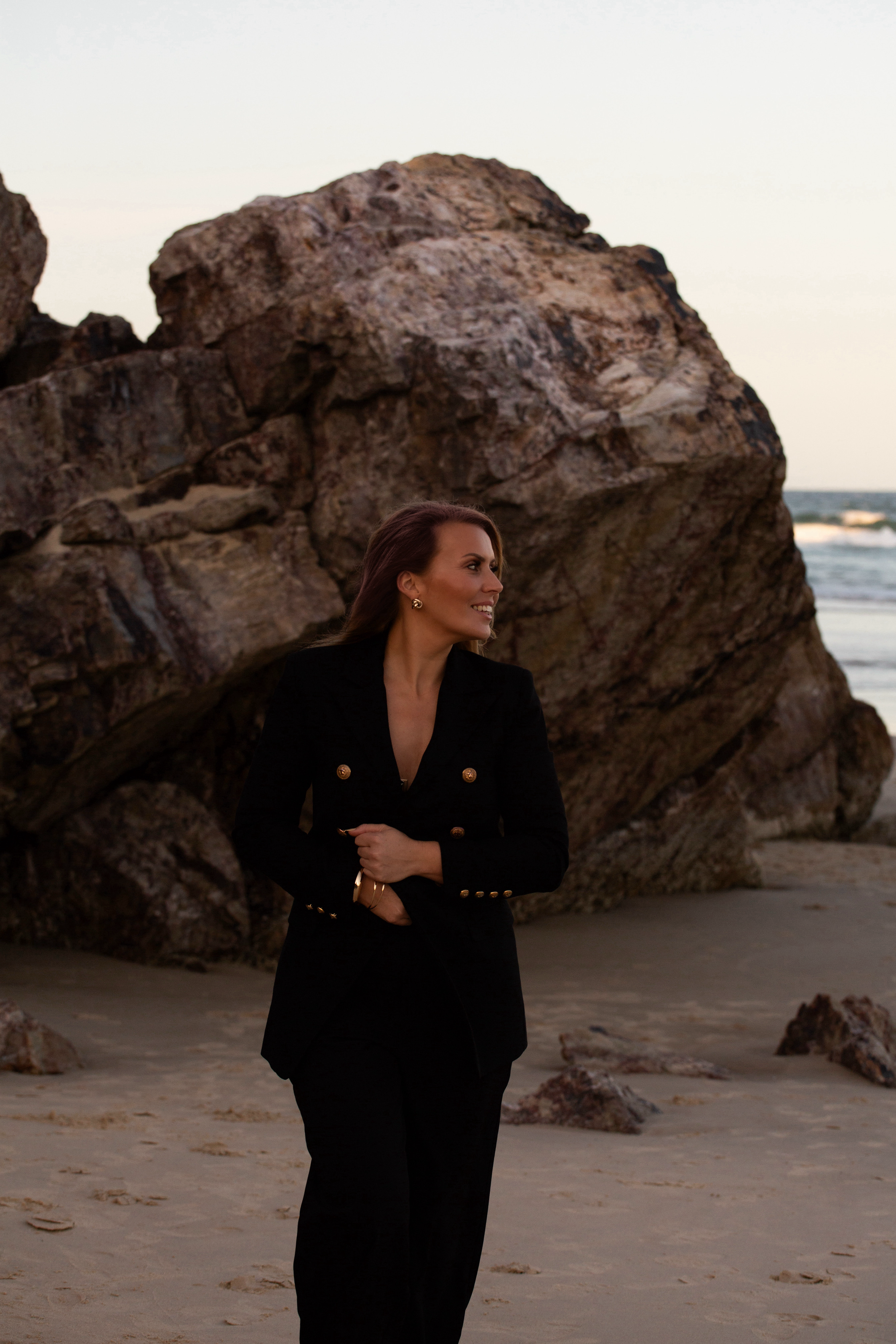


A woman smiling and running on a beach with large rocks in the background at sunset.
I was dieting by grade three.

I grew up being body shamed. And I grew up in the nineties where the message was everywhere, that if you were not thin enough, you were not beautiful enough. I absorbed all of it. And I arrived at the only conclusion that seemed available to me: that if I could just get thin enough, everything would finally be okay. That I would finally be lovable. Worthy. Enough.

So I got on the merry-go-round. Every plan. Every Monday. Every challenge that promised this time would be different. I weighed myself every morning and let the number decide what kind of day I was going to have. I restricted and then I binged and then I felt the shame and then I started over, again and again and again.

I did not stop until I was thirty-eight years old.

Not because I was weak. But because nobody ever told me the merry-go-round itself was the problem. Nobody ever helped me look underneath it.

The shift did not come from another plan. It came when I stopped trying to control the behaviour and started working with what was actually driving it. When I finally heard what my body had been trying to tell me all along, the pattern shifted. Not through force. Because my system no longer needed the coping strategy.

I found peace. Not perfect eating. Freedom.

That is what brought me to this work. And it is what I do for the women I work with now.

About Megan

Who I work with.

Most of the women who find me are not out of control.

They're capable, self-aware, highly functioning. They've done the therapy. They understand their patterns. They can articulate exactly where it comes from and why.

And yet food still has a grip.

Not because they're weak or lack discipline — but because their nervous system is still using food as a strategy. For relief. For control. For comfort, numbing, regulation, protection.

Understanding the pattern is not the same as shifting it. You can see exactly what's happening and still find yourself back in the same place. That's not a failure of insight. That's how protective systems work.

That's where my work begins.

How I work.

I'm an Internal Family Systems therapist. IFS works directly with the internal system driving the pattern, the parts of you that learned to use food when things got too heavy, too overwhelming, or too unsafe to process any other way.

We don't try to change the behaviour first. We work with the part underneath it.

Because until that part feels safe, it will keep doing what it has always done. But when it no longer needs to protect you in the same way, the pattern shifts. Not because you're trying harder. Because your system no longer needs the coping strategy.

This work is trauma-informed, nervous system-based, and grounded in IFS. It integrates parts work, somatic resourcing, and deep relational therapy to address what's actually driving the behaviour, not just the behaviour itself.

This is why the work lasts.

My training

  • Internal Family Systems Therapy Level 1 & Level 2, IFS Institute

  • Unburdened Bites: Healing Relationships with Food and Body Using IFS, Dr Kim Daniels

  • Somatic IFS Training, Life Architect

  • Somatic & Relational Trauma-Informed Practices for Medicine Assisted Facilitation, Australian Lab with Rita Bozi

  • Bright Line Freedom IFS Program, Bright Line Eating with Everett Considine

  • Wellness Coach Certification, IAP College

  • Psychology Studies, Monash University

Over 350 women have worked with me across private sessions, group containers, medicine-assisted journeys, and immersive workshops.

What women say after this work.

Not after hitting rock bottom. Not after everything falls apart. But when something underneath finally shifts.

They don't talk about discipline. They talk about relief.

"I'm not snapping like I used to.""Food doesn't run my day.""I've stopped bingeing.""I feel more like myself again.""I'm not constantly negotiating with myself anymore.""I don't feel guilty saying no.""I don't wake up thinking about what I ate."

If you can see yourself in any of this.

You don't have to keep figuring this out on your own.

You've probably already spent a long time trying. And if you've found your way to this page, I don't think it's by accident.

The first step is a free 30-minute consultation. A real conversation about your specific pattern, what's keeping it in place, and whether this work is the right fit for you.

If it is, we talk about what's next. If it's not, I'll tell you that honestly.